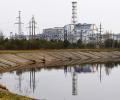
The Supreme Court is reviewing a plea challenging the 2025 SHANTI Act, which caps liability at Rs 3,000 crore for nuclear plant incidents, raising concerns about victim compensation and operator accountability.
Prime Minister Narendra Modi addressed NDA parliamentarians, emphasizing that laws and regulations should serve the convenience of the common people and not cause harassment.
Budget 2026 sticks to fiscal discipline, shuns populist measures despite five key state elections coming up, but ends up rattling stock markets with a higher transaction tax on derivatives trading.
West Bengal Chief Minister Mamata Banerjee has accused the BJP-led central government of using the proposed amendment to the women's quota law as a front for the Delimitation Bill, which she claims will divide the country. She asserted that her party will fight this move at every step.

Arvind Kejriwal has written to Delhi High Court Justice Swarana Kanta Sharma, stating he will not appear in the excise case personally or through a lawyer before her, citing concerns about impartiality.

Union Minister Kiren Rijiju has accused the Trinamool Congress (TMC) of being 'anti-women' and obstructing the passage of the women's reservation bill in Lok Sabha. He criticised the TMC's opposition to the bill and defended the BJP's commitment to increasing women's representation in politics.
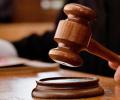
A Delhi court has ordered the confiscation of several properties belonging to UK-based arms consultant Sanjay Bhandari under the Fugitive Economic Offenders Act, following his declaration as a fugitive in a money laundering case.

Around 700 companies of Central Armed Police Forces (CAPF) will continue to remain deployed across West Bengal after the completion of polling, an Election Commission official said on Wednesday.
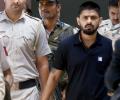
The Punjab and Haryana High Court has overturned the Centre's advisory against the release of ZEE5's docu-series, directing the makers to remove references to "Lawrence" and "Punjab" from the title.

The National Investigation Agency (NIA) has registered a case to probe the recovery of 79 crude bombs in West Bengal following a directive from the Union Home Ministry.

The only thing that might make the BJP stop trying to isolate Muslims completely will be if substantial numbers of the community vote for the party that flaunts its animosity towards it, notes Jyoti Punwani.
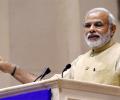
Following their success in the West Bengal assembly elections, BJP leaders are now focusing on winning the Punjab assembly polls in 2027, promising to rid the state of corruption and drugs under the leadership of Prime Minister Narendra Modi.

TVS Venu Group has agreed to acquire a minority stake of up to 9.9 per cent in Jana Small Finance Bank, including a 4.9 per cent ownership by TVS Motor Company, through a combination of primary issuance of warrants and a secondary purchase.
The Ministry of Information and Broadcasting has advised ZEE5 not to release 'Lawrence of Punjab', a docu-series on gangster Lawrence Bishnoi, after the Punjab Police expressed apprehension that it posed a risk to public order.

'Kashmir needs to be divided and we need the land of Panun Kashmir in Kashmir.'

Donald Trump has amplified a critique of birthright citizenship by sharing a video of Michael Savage, who claimed the legal system allows immigrants to exploit American laws.
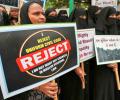
Union Home Minister Amit Shah announced the BJP's commitment to implementing the Uniform Civil Code in West Bengal within six months of assuming power, while also promising a Bengali chief minister.

Union minister Giriraj Singh's controversial remarks regarding the 'naqab' incident in Bihar have drawn criticism from opposition leaders, escalating the political row.

The ruling NDA coalition in India faces a significant challenge in passing the women's reservation bill in Parliament due to insufficient numbers. The bill requires a two-thirds majority in both houses, and the NDA needs to secure additional support or abstentions from other parties to achieve this.

The Indian government and opposition parties are set for a showdown in Parliament over a Constitution amendment bill concerning the implementation of the women's quota law and the delimitation exercise. The Opposition is concerned about the potential impact of delimitation on the political representation of southern states.
Union Home Minister Amit Shah accused West Bengal Chief Minister Mamata Banerjee of protecting infiltrators and alleged her associate wants to build a Babri Masjid in the state.

Union Home Minister Amit Shah promised one lakh jobs for youths each year based on merit if the BJP won the West Bengal election, and also pledged to make the state free of infiltrators.

National Testing Agency (NTA) director general Abhishek Singh on Tuesday said the schedule for the re-conduct of the cancelled NEET-UG 2026 examination would be announced within the next seven to ten days, while assuring students that strict action was being taken against those involved in the alleged paper leak.
A court in Sindhudurg has sentenced Maharashtra minister and BJP leader Nitesh Rane to one month's imprisonment in a 2019 case of pouring mud on an NHAI engineer, noting that lawmakers are not supposed to take the law into their hands.
Members of lottery 'king' Santiago Martin's family are contesting in the Tamil Nadu and Puducherry Assembly elections through three different political parties.

The conflict may disrupt Budget 2026-2027 projections, squeezing revenues and raising subsidies, prompting fiscal adjustments and potential reforms, echoing lessons from the Covid-era shock, points out A K Bhattacharya.
V D Satheesan, a 61-year-old lawyer-turned-politician, has emerged as a prominent figure in Kerala politics, known for his aggressive opposition to the Left government and his role in revitalising the Congress party. His journey from student politics to a key leadership position highlights his strategic acumen and dedication to addressing local issues.

Prime Minister Narendra Modi has appealed to the opposition to support the government's bills for implementing the women's reservation law, cautioning against politicisation and assuring that delimitation will be fair to all states.

The extent of doubts over the fairness of this election can be assessed by juxtaposing two figures: Total votes polled by the two principal parties and the number of people who were disallowed from voting this time, observes Nilanjan Mukhopadhyay.

The video is said to be of Mokama, which falls under Lalan's Munger Lok Sabha seat, where the former Janata Dal-United president's defence of party candidate Anant Singh in a murder case has already drawn flak from the Opposition.

India has established a high-level inter-ministerial body, the AI Governance and Economic Group (AIGEG), to steer the country's national AI governance strategy. The AIGEG will coordinate policy across ministries and oversee cross-sectoral governance issues, supported by a Technology and Policy Expert Committee (TPEC).

A Constitution Amendment Bill aimed at implementing 33 per cent reservation for women in legislatures and increasing Lok Sabha seats was defeated in Parliament, marking a setback for the government's efforts to empower women in politics.
The BJP and opposition parties are engaged in a political battle over the implementation of the Women's Reservation Act, with the BJP defending it as historic and the opposition accusing the government of delaying its notification and using it to push an unconstitutional delimitation exercise.
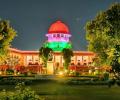
The Centre has asked the Supreme Court to reconsider its judgements decriminalising adultery and same-sex relationships, arguing they were based on a subjective application of 'constitutional morality'.
Union Home Minister Amit Shah addressed poll rallies in West Bengal, promising to tackle corruption and illegal immigration if the BJP comes to power. He criticised the current TMC government and outlined the BJP's plans for the state.

A nine-judge Supreme Court bench has reserved its order on petitions related to discrimination against women at religious places, including the Sabarimala temple, and the scope of religious freedom.

NDA leaders have defended proposed amendments to the Women's Reservation Act and the Delimitation Bill, 2026, arguing women have waited long enough for reservation, while opposition parties allege the process could undermine India's federal and democratic structure, particularly impacting southern states.
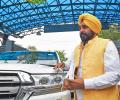
Punjab Chief Minister Bhagwant Mann criticised BJP leaders for blaming his government for the blast outside the BJP headquarters in Chandigarh, emphasising that the area falls under the Union Territory's administration. He also addressed other issues, including taxes and farmers' concerns.

West Bengal Chief Minister Mamata Banerjee has accused Prime Minister Narendra Modi of misleading the nation regarding the women's quota bill and plotting to push through the delimitation exercise by using women as a shield.

Prime Minister Narendra Modi appealed to Lok Sabha members to vote for the women's reservation bill, emphasising the need to empower women and rectify decades of political inaction.
